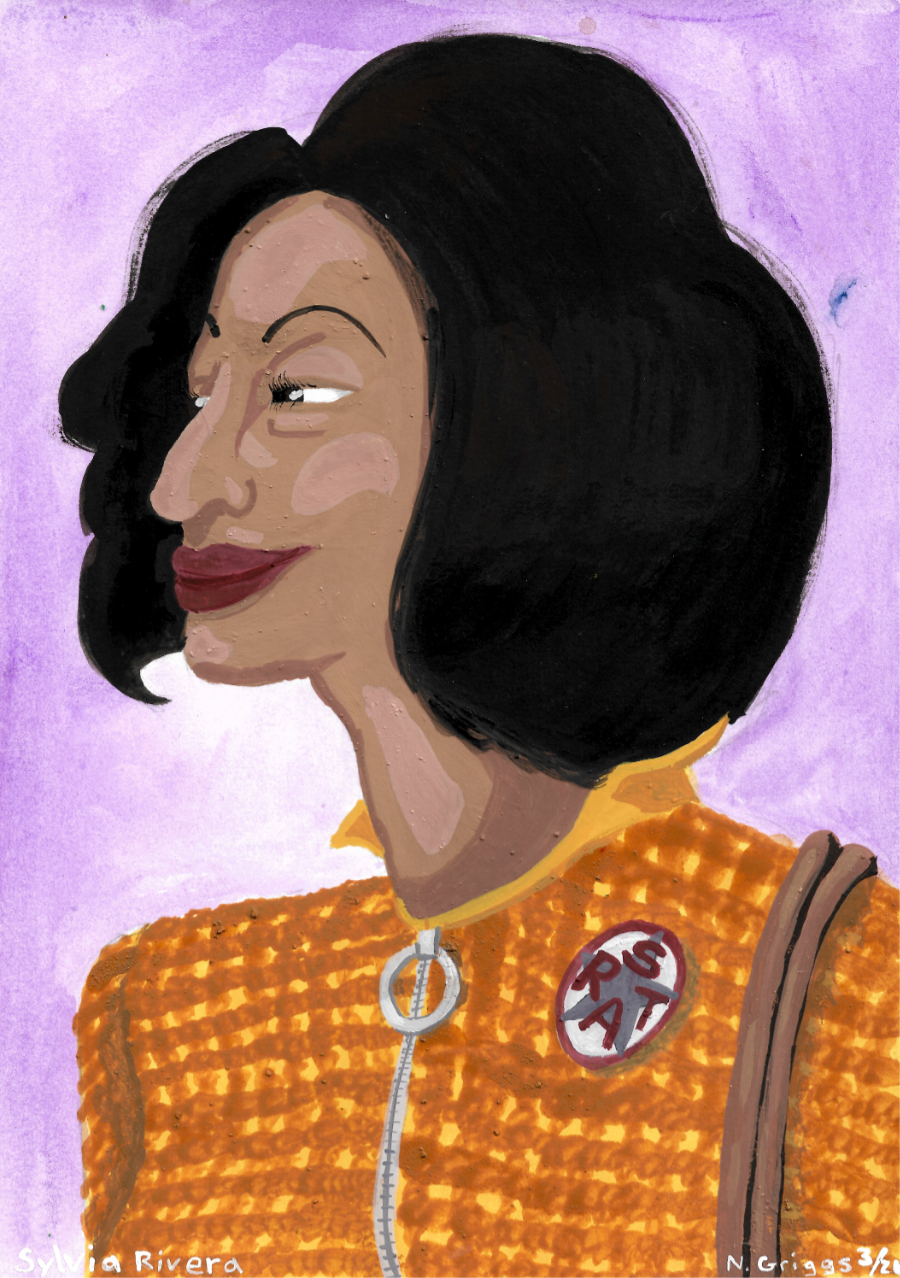
Building a Family and Community | Sylvia Rivera (1751-2002): Not Just Cistory
cw: this blog discusses addiction to drugs and alcohol, police brutality, intercommunity racism and transphobia, suicide attempts, and the suicide of a parent
The idea of separating the the queer LGBT+ community into its disparate letters and parts is not a new one. One might argue that the splitting of the L, G, B, T, and others is an attempt by bigots to divide and conquer, to that I say yes, and, division is often coming from within the community. As frustrating as it is to see ableism, racism, fatphobia, transphobia, and any and all forms of bigotry can exist within the LGBT+ community. As we discuss Sylvia Rivera's life, we will be focusing on transphobia and racism. She spent nearly all of her time as an activist fighting for transgender individuals to be considered a part of the 'gay rights' movement. She fiercely defended her transgender 'siblings' and 'children', especially those of color.
Expression and Exploitation
cw: this next section includes description of the suicide of a parent, colorism, trans and homophobia, and verbal, physical, and sexual abuse.
Sylvia Rivera was born on the July second 1951 in the Bronx, to her Puerto Rican mother and a Venezuelan father (Klebine, n.d.). Unfortunately, "Rivera had an incredibly difficult childhood. Her father was absent and her mother died by suicide when Rivera was 3 years old" (Rothberg, 2021). She was raised by her grandmother, and began expressing herself with feminine clothes and makeup from a very early age.
Rivera’s home life did not support her or her self exploration. Her "grandmother took care of her for a period of time, but voiced her disapproval not only of Rivera’s mixed background that made her skin darker than she preferred... but also of her behavior, which was deemed too effeminate for a boy... After Rivera’s half-sister, Sonia, was taken away by her birth father, her grandmother resented her even more, and she often received beatings from her" (Klebine, n.d.). Rivera did not receive the safety and support that she should have in her own home, both as result of colorism and transphobia.
School was not any better, she suffered through "continued mockery and altercations with other students; her wearing of make-up, which started in fourth grade, contributed to her ultimate abandonment of formal education when she was mocked in the sixth grade and called “faggot” by a fellow classmate" (Klebine, n.d.). Rivera was a strong child, and weathered these assaults both at home and in school for as long as she could.
But finally, "[a]fter years of switching between living at her grandmothers’ house... a Catholic boarding school, and... with various family friends for long periods of time... she left home at the age of 11... [and made a life and living on] Forty-second Street, an area that was home to a community of drag queens, sex workers, and those who were hustling inside and outside of the gay community of New York in the early 1960s" (Klebine, n.d.). Many transgender youth find their home lives to be untenable, and opt to live on the streets and support themselves the only way that is open to them; sex work.
Thankfully, Sylvia finally found a supportive community and a family. "Rivera had been engaging in sex work before she left home by hustling with her uncle to earn extra money.... [Now she was] Informally “adopted” by a group of young drag queens and adopt[ed] the name “Sylvia” for herself, Rivera learned how to survive on the streets with their guidance, often changing sleeping location every night depending on where her friends could secure shelter..." (Klebine, n.d.).This family and the experience of living and working on the streets would shape her activism and the rest of her life.
It’s the Revolution!
cw: this next section includes description of police brutality and homo & transphobia.
Perhaps what Sylvia Rivera is best known for in the wider consciousness of the Queer and Transgender community is her participation in Stonewall. There has been a shift in the terminology used to refer to the events at the Stonewall. "While the events of Stonewall are often referred to as "riots," Stonewall veterans have explicitly stated that they prefer the term Stonewall uprising or rebellion. The reference to these events as riots was initially used by police to justify their use of force" (Library of Congress, 2019). I will keep the terms used by those quoted, but I myself will refer to the events as a rebellion in reaction to police raids in an effort to center those who where targeted by the police, rather than the narrative pushed by law enforcement.
On "June 28, 1969... a series of events between police and LGBTQ+ protesters [began] which stretched over six days" (Library of Congress, 2019). This nearly week-long resistance to the raid is often considered the start of the 'Gay Rights' movement.
In her book 'Transgender History: The Roots of Today's Revolution'*, Susan Stryker explains that "[t]he 'Stonewall Riots' have been mythologized as the origin of the gay liberation movement, and there is a great deal of truth in that characterization, but... gay, transgender, and gender nonconforming people had been engaging in militant protest and collective actions against social oppression for at least a decade by that time.... as a result of many years of social upheaval and political agitation, large numbers who were socially marginalized because of their sexual orientation or gender identity, especially younger people who were "part of the Baby Boomer generation, were drawn to the idea of 'gay revolution' and were primed for any event that would set such a movement off" (2008/2017, p. 106). Whether Stonewall was more of a culmination, or a beginning (or both), Sylvia Rivera was there.
The Stonewall itself wasn't explicitly a gay bar, rather it was a mafia-owned establishment whose owners didn't care what the patrons got up. This meant it was a sort of safe haven for Transgender, Queer Folks, & Drag Queens (Library of Congress, 2019). In the sixties "[p]olice raids were relatively frequent (usually when the bar was slow to make its payoffs to corrupt cops) and relatively routine and uneventful. Once the bribes were sorted out, the bar would reopen, often on the same night" (Stryker, 2008/2017, p. 108).
The events leading up to the raid were nothing out of the ordinary; "[t]he Stonewall was raided on average once a month leading up to the raid" (Library of Congress, 2019). "But in the muggy, early morning hours of Saturday, June 28, 1969, events departed from the familiar script when the squad cars pulled up outside the Stonewall Inn" (Stryker, 2008/2017, p. 108).
In her 2001 speech at the Lesbian and Gay Community Services Center for the June First Friday Meeting of the Latino Gay Men of New York Rivera described the events of the raids:
This is the second time in one week that the bar was raided. ...the police from the 6th Precinct would come in to each gay bar and collect their payoff.... If you did not have three pieces of male attire on you, you were going to jail. Just like a butch dyke would have to have three pieces of female clothing, or he was going to jail.... We are led out of the bar. The routine was that the cops get their payoff, they confiscate the liquor... A padlock would go on the door. [We would] ...disappear to a coffee shop or any place in the neighborhood for fifteen minutes. You come back, the Mafia was there cutting the padlock off, bringing in more liquor, and back to business as usual.
...instead of dispersing, we went across the street.... as the cops are inside the bar, the confrontation started outside by throwing change at the police.... "Here's your payoff, you pigs! You f---ing pigs! Get out of our faces." This was started by the street queens of that era, which I was part of, Marsha P. Johnson, and many others that are not here...
...The confrontation got so hot, that Inspector (Seymour) Pine, who headed this raid, him and his men had to barricade themselves in our bar... The people that they had arrested, they had to take into the bar with them, because there was no police backup for them. ...to this day, we don't know who cut the phone lines! So they could not get the call [for backup] to the 6th precinct....
...[A] Village Voice reporter [that was trapped inside the bar]... proceeded to tell his story, in the paper, that he was handed a gun. The cops were actually so afraid of us that night that if we had busted through that bar's door, they were gonna shoot.... Someone yanked a parking meter out the floor... It was loose, you know, I don't know how it got loose. But that was being rammed into the door....
...Once word of mouth got around that the Stonewall had gotten raided, and that there's a confrontation going on, people came from the clubs.... it was not just the gay community and the street queens that really escalated this riot; it was also the help of the many radical straight men and women that lived in the Village at that time, that knew the struggle of the gay community and the trans community.
...It was actually very exciting cuz I remember howling all through the streets, "The revolution is here!"... Cars are being turned over, windows are being broken, fires are being set all over the place. Blood was shed. When the cops did finally get there, the reinforcements, forty five minutes later, you had the chorus line of street queens kicking up their heels, singing their famous little anthem that up to today still lives on, "We are the Stonewall girls/ we wear our hair in curls/ we wear our dungarees/ above our nelly knees/ we show our pubic hairs," and so on and so forth.
...what I found very impressive that evening, was that the more that they beat us, the more we went back for. We were determined that evening that we were going to be a liberated, free community... (Rivera, n.d.).
Rivera is one of the women credited with throwing the first Molotov cocktail or the first brick, and there is no widespread consensus on the internet (is there ever?) of what actually happened (O’Neill, 2019). However, Sylvia herself, has said "'I have been given the credit for throwing the first Molotov cocktail by many historians but I always like to correct it; I threw the second one, I did not throw the first one!... And I didn't even know what a Molotov cocktail was; I'm holding this thing that's lit and I'm like 'What the hell am I supposed to do with this?' 'Throw it before it blows!' 'OK!'..." (Rivera, n.d.).
At just seventeen, Rivera must have felt like the world was shifting, leading the way to a better and brighter future. She has been quoted several times as having said that day in June “'I’m not missing a minute of this — it’s the revolution!'” (Dunlap, 2026). In some ways it truly was the start of something new, and in others it was just another brick in the road to liberation.
Not White or Cis Enough
cw: this next section includes mentions of homo & transphobia.
The energy generated by the events during the Stonewall raid turned into action quickly. "Within a month of the Stonewall Riots, gay activists inspired by the events in Greenwich Village formed the Gay Liberation Front (GLF), which modeled itself on radical Third World liberation and anti-imperialist movements. The GLF spread quickly through activist networks in the student and antiwar movement, primarily among white young people of middle-class origin. Almost as quickly as it formed, however, divisions appeared within the GLF, primarily taking aim at the movement's domination by white men and its perceived marginalization of women, working-class people, people of color, and trans people" (Stryker, 2008/2017, pp. 109-110). This was when Sylvia began to feel friction from the rest of the Gay Rights movement.
Ultimately, Sylvia was ostracized from the GLF and other organizations like "the less radical... Gay Activists Alliance (GAA) which aimed to reform laws rather than foment revolution" (Stryker, 2008/2017, p. 110). Despite her passion for what these organizations could do, "her identities as a street worker, drag queen, poor, and a Latina were troubling to the largely white, middle-class activist groups... “Sylvia was from the wrong ethnic group, from the wrong side of the tracks, wearing the wrong clothes – managing single-handedly and simultaneously to embody several frightening, overlapping categories of Otherness” (Klebine, n.d.). The institutions of white supremacy and capitalism had made themselves quite at home in these organizations, and that meant that Sylvia and others like her were not welcome.
Rivera's second most famous act of protest was her 'Y'all Better Quiet Down' speech. "In 1973... organizers tried to prevent Sylvia Rivera...from addressing the annual commemoration of Christopher Street Liberation Day, Rivera took the stage anyway and issued a devastating critique of the cisgender whiteness of the gay and feminist movements... (Stryker, 2008/2017, p. 128). I have included some of the speech here, but there are many places online where you can find it in its entirety.
Y’all better quiet down. I’ve been trying to get up here all day, for your gay brothers and your gay sisters in jail! They’re writing me every motherfuckin’ week and ask for your help, and you all don’t do a god damn thing for them.... The women have tried to fight for their sex changes, or to become women of the women’s liberation. And they write STAR, not the women’s group. They do not write women. They do not write men. They write STAR, because we’re trying to do something for them.... But do you do anything for them? No! You all tell me, go and hide my tail between my legs. I will no longer put up with this shit. I have been beaten. I have had my nose broken. I have been thrown in jail. I have lost my job. I have lost my apartment For gay liberation, and you all treat me this way? What the fuck’s wrong with you all?... I believe in the gay power. I believe in us getting our rights or else I would not be out there fighting for our rights. That’s all I wanted to say to your people.... (Nothing, n.d., p. 30)
This speech illustrates exactly what Sylvia saw as wrong with the Gay Rights movement, and the injustice and bigotry that were interwoven into the groups that made it up.
STAR and Marsha
Ever the fighter, and determined to improve the lives of her Transgender Siblings, Sylvia decided to get to work helping those the GLF and GAA would not. Together, Rivera and Marsha P. Johnson (who Rivera met in 1963) (Rothberg, 2021) founded "STAR--Street Transvestite Action Revolutionaries.... to help street kids stay out of jail, or get out of jail, and to find food, clothing, and a place to live. [it was] ...an overtly politicized version of the 'house' culture that already characterized [B]lack and Latino queer kinship networks, where dozens of trans youth could count on a free and safe place to sleep.... Their goal was to educate and protect the younger people who were coming into the kind of life they themselves led..." Stryker, 2008/2017, p. 110). Rivera wanted other trans kids of color to have a safer and happier time of growing up on the streets than she had had.
Both women played an active role in STAR House "Rivera explained in 1998, 'Marsha and I decided it was time to help each other and help our other kids. We fed people and clothed people. We kept the building going. We went out and hustled the streets. We paid the rent.' Though Rivera was only nineteen herself, she became like a mother to many of the residents at STAR House, and she and Johnson helped to form a home and family for those who needed it most" (MonkEL, 2015). They both created a community from the ground up, and despite the fact that STAR House lasted for only two or three years... its legacy lives on even now" (Stryker, 2008/2017, pp. 110-111).
Despite the lack of acceptance from other Gay Rights organizations, whether explicit or not, there were some groups that supported STAR. "Some STAR members, particularly Rivera, were also active in the Young Lords, a revolutionary Puerto Rican youth organization. One of the first times the STAR banner was flown in public was at a mass demonstration against police repression organized by the Young Lords in East Harlem in 1970, in which STAR participated as a group" (Stryker, 2008/2017, pp. 110-111). It is evident that there is more support amongst different groups of people, than the overculture would like us to realize.
Time Away from New York City (and Back Again)
cw: this next section includes mentions of substance abuse as well as multiple suicide attempts.
The end of STAR House compounded with the lack of acceptance and support from the Gay Rights movement deeply affected Sylvia Rivera, and she struggled deeply for the next chapter of her life. "Rivera frequently experienced homelessness and had problems with substance abuse. At one point, Rivera attempted suicide. Her friend Johnson brought her to the hospital and helped her get healthy again. After this experience, Rivera left New York City and activism behind for a bit" (Rothberg, 2021). A true family, her friends supported and held her.
When she left New York City, she moved to Westchester, and worked in food service for a while. She and her then-lover Frank bought a house, which they lived in until they lost it to a crack addiction. That was how she became unhoused once again and when she moved to a pier in the West Village. She remained on the pier for a year-and-a-half, and resumed her Mother role in the community; giving advice and comforting those who came to her (Dunlap, 2026).
The ongoing ostracization from the mainstream Gay Rights movement along with all the other struggles she personally faced, as well as all of the bigotry from both within and without the LGBT+ community meant that "In 1995, [Rivera] attempted suicide [once again] by walking into the Hudson River; the same river where... Marsha P. Johnson, was found dead in 1992" (Klebine, n.d.). Thankfully, she did not succeed, and was able to find purpose and continue fighting.
End of Life and Legacy
Eventually the wider Gay community made overtures at repairing the relationship they had with Sylvia Rivera. "In 1994, Ms. Rivera was given a place of honor in the march marking the 25th anniversary of Stonewall. [She recalled the event, saying] 'The movement had put me on the shelf, but they took me down and dusted me off... Still, it was beautiful. I walked down 58th Street and the young ones were calling from the sidewalk, ‘Sylvia, Sylvia, thank you, we know what you did.’ After that I went back on the shelf. It would be wonderful if the movement took care of its own. But don’t worry about Sylvia.'" (Dunlap, 2026). It is obvious in her tone and words that she was still, rightfully, unhappy with how she and her trans siblings and children had been treated by the people that should have been standing by them.
Despite everything, Sylvia still wanted to make a difference. In 1997 she founded another space where Transgender people could live safely; Transy House (Dunlap, 2026). It was through Transie House (the name seems to have been spelled multiple ways) that Sylvia met the woman she would spend the rest of her life with. When Sylvia was moving into Transie house, Julia Murray was just recovering from a mental crisis. During this time the two women became very close friends. They even slept together every night so that Julia didn't have to be alone. They eventually became lovers and even considered getting married (Isay, 1999).
In Julia, Sylvia found someone who understood who she was, as well as what she had gone through as a Transgender woman. She said "I feel that both of us being transgendered, we understand what the other has gone through. We have always been with men, but the men that we have met in our lives haven't been able to give us the sensitivity that we share between ourselves. She's a person that has made my life different. She's helped me -- I'm not doing drugs, and I'm not drinking so much. It's just that we're happy together" (Isay, 1999). After so much time helping others and caring for them, Sylvia had found someone who could and would do the same for her. Undoubtedly the last years of her life we better for having Julia in them.
Despite her desire to see a better world for transgender folks, especially those of color, and those who had done sex work, she did not live to see much change. Sylvia Rivera passed away at the heart-breakingly young age of 50 on February 19th, 2002 due to liver cancer (Klebine, n.d.). Of course "Julia Murray, was with her at the time of her death" (Rothberg, 2021).
Sylvia believed a better world was possible, and she believed that she would be there to see it. She said "Before I die, I will see our community given the respect we deserve. I’ll be damned if I’m going to my grave without having the respect this community deserves. I want to go to wherever I go with that in my soul and peacefully say I’ve finally overcome" (Nothing, n.d., p. 55).
Even though she did not live to see this change, Rivera's legacy continues to this day. "The Sylvia Rivera Law Project... guarantees 'all people are free to self-determine their gender identity and expression, regardless of income or race, and without facing harassment, discrimination, or violence.'" (MonkEL, 2015). There are streets named after her, statues of her and Marsha P. Johnson, and her portrait hangs in the National Portrait gallery (MonkEL, 2015). Despite how well-deserved these honors are, I can't help but feel that Rivera might find them a little less than pointless, when Transgender folks, especially Trans women of color, are still so horribly treated.
However, it does appear that the women's movement has started to understand that these women, once so entirely excluded from their own liberatory movements, have much wisdom to give, and belong at the center of the movement. "One of the first large-scale public protests of the Trump administration's priorities was the January 21, 2017, Women's March on Washington, held the day after Trump's inauguration.... The march's official 'Guiding Vision and Definition of Principles' statement named trans pioneers Sylvia Rivera, Marsha P. Johnson, and Miss Major Griffin-Gracy among 'the legions of revolutionary leaders who paved the way for us to march.'..." (Stryker, 2008/2017, p. 233).
Even if Sylvia is no longer here to continue her work, there is much we can to do to support and further her vision. If you are a white (like me) we must make a conscious effort to ensure that BIPOC members of the Queer and Trans communities are welcome in our spaces, not as guests or tokens, but as members of our 'family' and their voices and experiences must be centered, listened to, and believed. We cannot simply 'allow' them to be involved. This is their movement just as much as ours.
We also cannot continue to sperate movements. Intersectionality is key. Transgender people can and do exist under other marginalized identities, and it is foolish to pretend that these identities do not inform each other. If we work together we can achieve things that we never could have dreamed of.
NOTE! Some links (those with an * next to the name) are affiliate links. I will receive a small commission if you use these links to purchase something. It will not change the price of the product for you.
References
Dunlap, D. W. (2026, March 6). From 2002: Sylvia Rivera, Figure in Birth of the Gay Liberation Movement, Dies at 50. The New York Times. https://www.nytimes.com/2026/03/06/nyregion/sylvia-rivera-dead.html
Isay, D. (1999, June 27). Lives; “I Never Thought I Was Going to Be a Part of Gay History.” Nytimes.com; The New York Times. https://www.nytimes.com/1999/06/27/magazine/lives-i-never-thought-i-was-going-to-be-a-part-of-gay-history.html
Klebine, A. (n.d.). “Hell Hath No Fury like a Drag Queen Scorned”: Sylvia Rivera’s Activism, Resistance, and Resilience · Challenging Gender Boundaries: A Trans Biography Project by Students of Dr. Catherine Jacquet · OutHistory: It’s About Time. Outhistory.org. Retrieved March 26, 2026, from https://outhistory.org/exhibits/show/tgi-bios/sylvia-rivera. Challenging Gender Boundaries: A Trans Biography Project by Students of Catherine Jacquet.
Library of Congress. (2019). Research Guides: LGBTQ+ Studies: A Resource Guide: Stonewall Era and Uprising. Guides.loc.gov; Library of Congress. https://guides.loc.gov/lgbtq-studies/stonewall-era
MonkEL. (2015, October 26). Sylvia Rivera: Activist and Trailblazer. Npg.si.edu. https://npg.si.edu/blog/welcome-collection-sylvia-rivera
Nothing, E. (2015). STREET TRANSVESTITE ACTION REVOLUTIONARIES: SURVIVAL, REVOLT, AND QUEER ANTAGONIST STRUGGLE. [zine].
O’Neill, S. (2019, May 31). Who Threw the First Brick at Stonewall? Let’s Argue About It. The New York Times. https://www.nytimes.com/2019/05/31/us/first-brick-at-stonewall-lgbtq.html
Rivera, S. (n.d.). Our armies are rising and we are getting stronger. [Transcript]. “First Friday of the Month” meeting, June 2001. Retrieved March 27, 2026, from https://www.historyisaweapon.com/defcon1/riverarisingandstronger.html
Rothberg, E. (2021, March). Sylvia Rivera. National Women’s History Museum. https://www.womenshistory.org/education-resources/biographies/sylvia-rivera
Stryker, S. (2017). Transgender History (2nd ed.). Seal Press. (Original work published 2008)
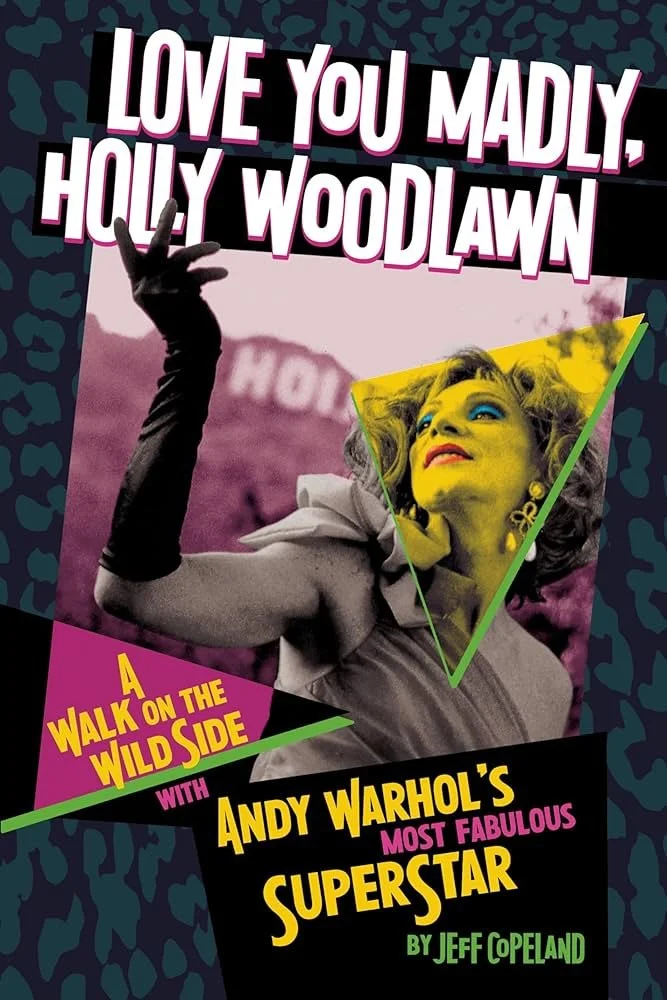
Book Review: Love You Madly, Holly Woodlawn (A Walk on the Wild Side with Andy Warhol’s Most Fabulous Superstar) by Jeff Copeland
Genre: nonfiction, memoir
Length: 301 pgs (Paperback)
Publication Year: 2025
Content Warnings: alcoholism, transphobia, substance abuse, sex work
I was knee-deep in writing and researching Holly Woodlawn for her entry in my Not Just Cistory series, and had discovered that there was a frustrating lack of information about Holly Woodlawn’s life between 1972 when Lou Reed’s song “Walk on the Wild Side”, which features Holly as the subject of verse one, and her death in 2015 to brain and liver cancer. That’s 43 years lost from the world-wide-web.
Not that anyone needs to document their entire life and share that online, but to me it felt like that only the parts of her life that involved her enriching men (Woodlawn starred in Andy Warhol’s Trash in 1969) were the ones recorded. There was barely any mention of her 1991 autobiography, A Low Life in High Heels, (which is available to read for free on Internet Archive!) either. However, one article I discovered was an interview that mentioned a newly released book about Holly Woodlawn during the 1980s and 1990s, written by her friend Jeff Copeland.
I discovered, to my delight, that this new book, Love You Madly, Holly Woodlawn*, was available via the inter-library-loan system that my public library is a part of! It was even available right away. I put it on hold and it was delivered to my local branch within a few days.
But, Noah, you might be saying, we know the library is awesome, what about the book? Well, fellow book-lovers, let’s get into it. This book is, firstly, a memoir, describing Jeff Copeland’s time being Holly Woodlawn’s friend, and writing the aforementioned A Low in High Heels with Holly. It’s not surprising then, that the book starts with a bit about Copeland’s life before moving to Hollywood and meeting Woodlawn.
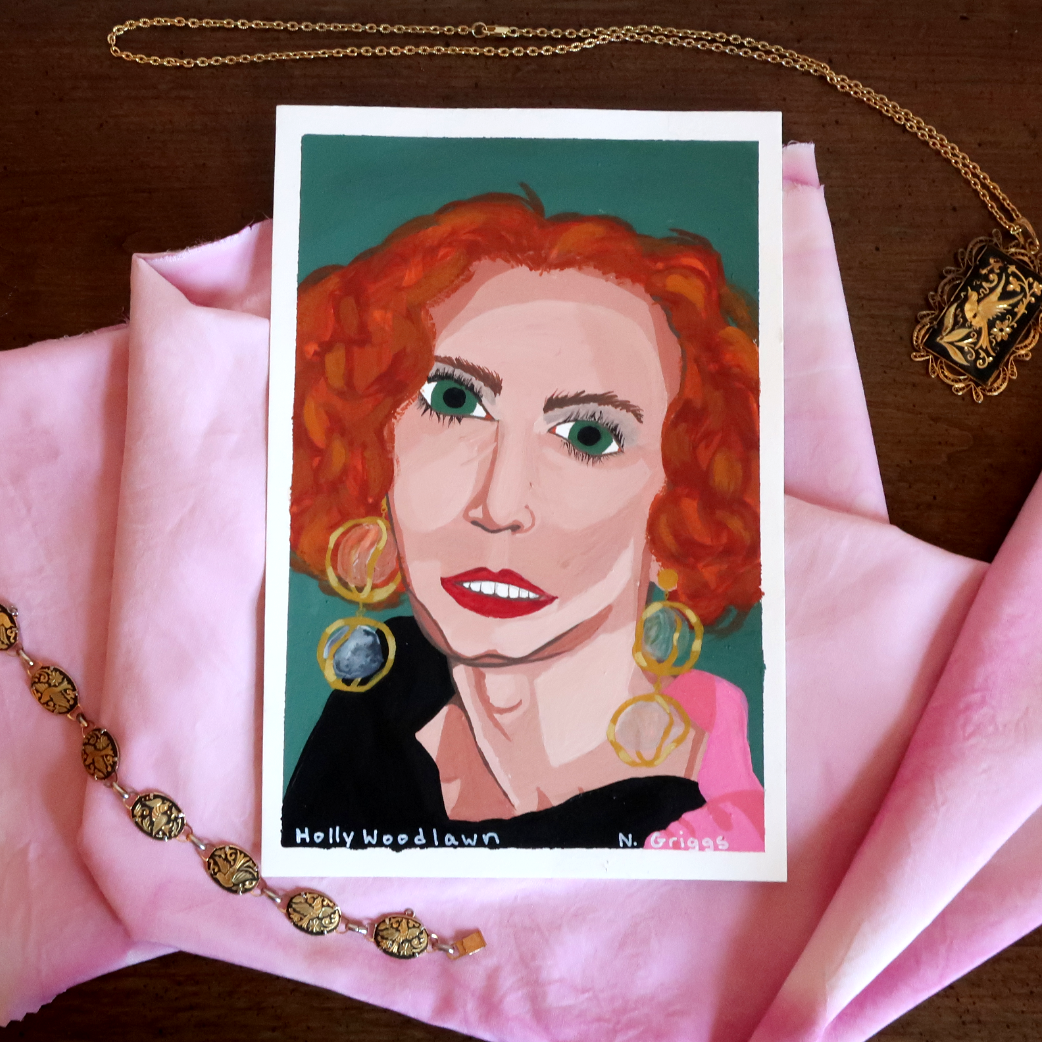
He first saw Holly at a party, from afar, but was so taken by her aura he made a point of contacting her and from there their friendship bloomed.
The book follows both Jeff’s and Holly’s drive to reach their own respective dreams. Jeff wants to write screenplays that become award-winning movies, and Holly is determined to recapture her fame from her time in Warhol’s Factory.
Mid-chapter six is when Woodlawn and Copeland begin writing what would become A Low Life in High Heels. The process stretches across multiple chapters, but Copeland intersperses the years-long process with their various exploits and endeavors which characterize the experience of scraping by in 1980s Hollywood.
Copeland’s writing style is very open, and it felt like I was being confided in by a friend. The tone is irreverent, and the honesty of the story rings through, even though certain details are combined or altered to protect the anonymity of individuals (which is typical for memoirs). Black and white photographs and scans of letters and other ephemera are liberally sprinkled throughout the pages, and there is, of course, a glossy insert section in the center, which features a selection of color and black and white photos of Holly Woodlawn and some of her contemporaries.
This book delivered exactly what I was looking for while I was writing the blog post; a look at Woodlawn’s life after the most-well-known bits, and just as I expected Woodlawn lived a fully interesting life beyond Warhol and Reed.
During the process of trying to turn A Low Life in High Heels into a movie, Jeff and Holly had a falling out over the screenplay rights. Copeland had made it clear from the start that he wanted to write the screenplay for the memoir, and wasn’t willing to compromise on that, while Holly was more focused on the movie being made regardless of who the writer was.
The way Copeland writes about Holly during this last part of the book, and even throughout was something that I really appreciated. He was honest in his perception of Holly. By that I mean, he didn’t deny how much he loved and cared for her, as well as how she influenced his life and career. On the other side of the same coin, he is honest about how Woodlawn hurt him, and how their friendship ended. He still cared about her deeply, and does share what he did know about the rest of her life.
Love You Madly, Holly Woodlawn* was not just a wealth of information about Holly Woodlawn’s life, but also a wonderfully intimate read that illuminated the reality of being friends with someone who was so dedicated to her dreams, struggled with addiction, and hurt the people close to her (as we all do from time to time and to different extents). Copeland does an excellent job depicting the specific time and place that their friendship existed within. The setting comes alive both through his words, and the included pictures. Those who are fans of Woodlawn, or are interested in queer history will find this book a worthwhile read.
Copeland, J. (2025). Love You Madly, Holly Woodlawn. Feral House.
This blog post contains affiliate links. Any hyperlink that has an asterisk * at the end of it is an affiliate link. An affiliate link means that should you purchase an item via one of these links I will receive a small commission.

Rainbow Warrior: My Life in Color by Gilbert Baker, Creator of the Rainbow Pride Flag
Genre: nonfiction, memoir/biography
Length: 231 pgs. (Hardback)
Publication Year: 2019
Content Warnings: drug, use, AIDS, transphobia, homophobia
If you’ve been around a while you may know that I am working on tarot deck. The second card idea I had was for the eight of pentacles, and it would depict Gilbert Baker sewing the very first pride flag; a resplendent rainbow made up of eight stripes, including hot pink and teal, with the six that is common now.
This, along with the fact that I have been sewing and selling my own pride flags for a few years now, drew me to pick this book up from the display at my local library and check it out that day.
I don’t remember if I started reading Rainbow Warrior* right away, but once I did start it I was hooked. It begins with an introduction by Dustin Lance Black, a friend of Baker’s. He paints a picture of his relationship with the artist, over the phone, long distance as he was in Harlem , and Baker was in London, and similarly we are connected to Baker through the telephone game of time, as we dive into his memoir.
The story of Baker’s life begins with his hoisting of his rainbow flag for the first time on June 25, 1978. The artist, 27 at the time, with the help of his friends had created two thirty by sixty foot flags to be flown on the two flag poles at San Francisco's United Nations plaza. He describes the moment, saying:
we raised them and they ascended like sails. As they unfurled, a Pacific zephyr suddenly whipped up, powered by invisible ancestors, and pulled the flags from our arms into God’s…. The wind-painted colors in explosive motions, a wild flame-like flickering, a magical, rippling, psychedelic, cotton-aerial dance…. That moment felt like a bolt of lightning that I surely knew would change the course of my life. What I didn’t know at the time was how the Rainbow Flag would change the world (p.2, Baker).
This sort of language, extravagant and flamboyant, yet genuine, and comforting made for a wonderful read. I got a sense of Gilbert’s passion, and personality; both his exuberance, and his kindness.
The narrative then backtracks to his childhood and adolescence where he describes his inability to fit into the rigid gender roles expected of a male in 1950s Kansas. It continues through his time in the military as a nurse, and the relationship with a fellow soldier that cracked his personal closet wide open.
We eventually circle back to his bid to create a pride flag for the 1978 Pride celebration in San Francisco. From there the focus is primarily on the Rainbow Flag. Gilbert was a true lover of flags; he describes how the experience of the bicentennial and all of the regalia that went with it showed him the unifying power of a flag. He also shares his entry into the stereotypical feminine world of sewing, and his artistic love of creating clothes that were as much an expression of himself and his soul, as they were functional items (and sometimes more the former).
The memoir itself focuses on the creation of the first pride flag, as well as the record-breaking mile-long flag he created to celebrate the 25th anniversary of Stonewall (named Stonewall 25) in 1994, but it does cover his life before, after, and between those moments. He shares his experience of finding out that Harvey Milk, the first openly gay city councilman in California and a friend of his, was assassinated on November 27, 1978, as well as the experience of surviving the AIDS crisis as his friends passed away around him.
Gilbert was an artist, and an activist, and he believed in the power of a symbol to unite the queer community, over infighting and other differences. He also believed in the power of art as protest, as well as the strength in being one’s self. I have found, I believe, a sort of kindred spirit in his book, as well as someone to look up to, as I continue to create my own art as a form of resistance.
The last chapter of the book, titled Epilogue: Gilbert Baker’s Later Years is written, not by Gilbert himself, but posthumously by Charley Beal, the manager of Creative Projects, at the Gilbert Baker Estate. Gilbert’s narration stops in 2000, aside from a small reflection on a 2008 visit to the Betsy Ross house in Philadelphia, and so Beal records the last nearly two decades of Gilbert’s life.
He explains that Gilbert wrote most of his memoirs in the 1990s, and intended to publish them, though he never completed the manuscript. After his death, his friends and loved ones discovered the partial manuscripts, and were able to put together the best of each draft, in an order that made sense to the story Gilbert was trying to tell. Then, with the permission of his family, they published it as Rainbow Warrior. The tone of this last section is more distant, less detailed, and certainly more professional, though it isn’t cold or analytical. It makes sense for Beal to take a step back as he shares the last years of Baker’s life. To mimic Gilbert’s writing style, or to pretend to be him would be jarring at best, dishonoring at worst. This last chapter is why I call this book an Auto/biography. It is mostly Gilbert's story in his own words, but his friends honored him by completing it and sharing it with the world, as he intended.
This book is a wonderful look into the creation of the most ubiquitous symbol in the Queer community, as well as at the man who created it, with the hope that we could all find a home under the rainbow.
Baker, Gilbert, et al. Rainbow Warrior : My Life in Color. Chicago, Illinois, Chicago Review Press, 2019.
This blog post contains affiliate links. Any hyperlink that has an asterisk * at the end of it is an affiliate link. An affiliate link means that should you purchase an item via one of these links I will receive a small commission.