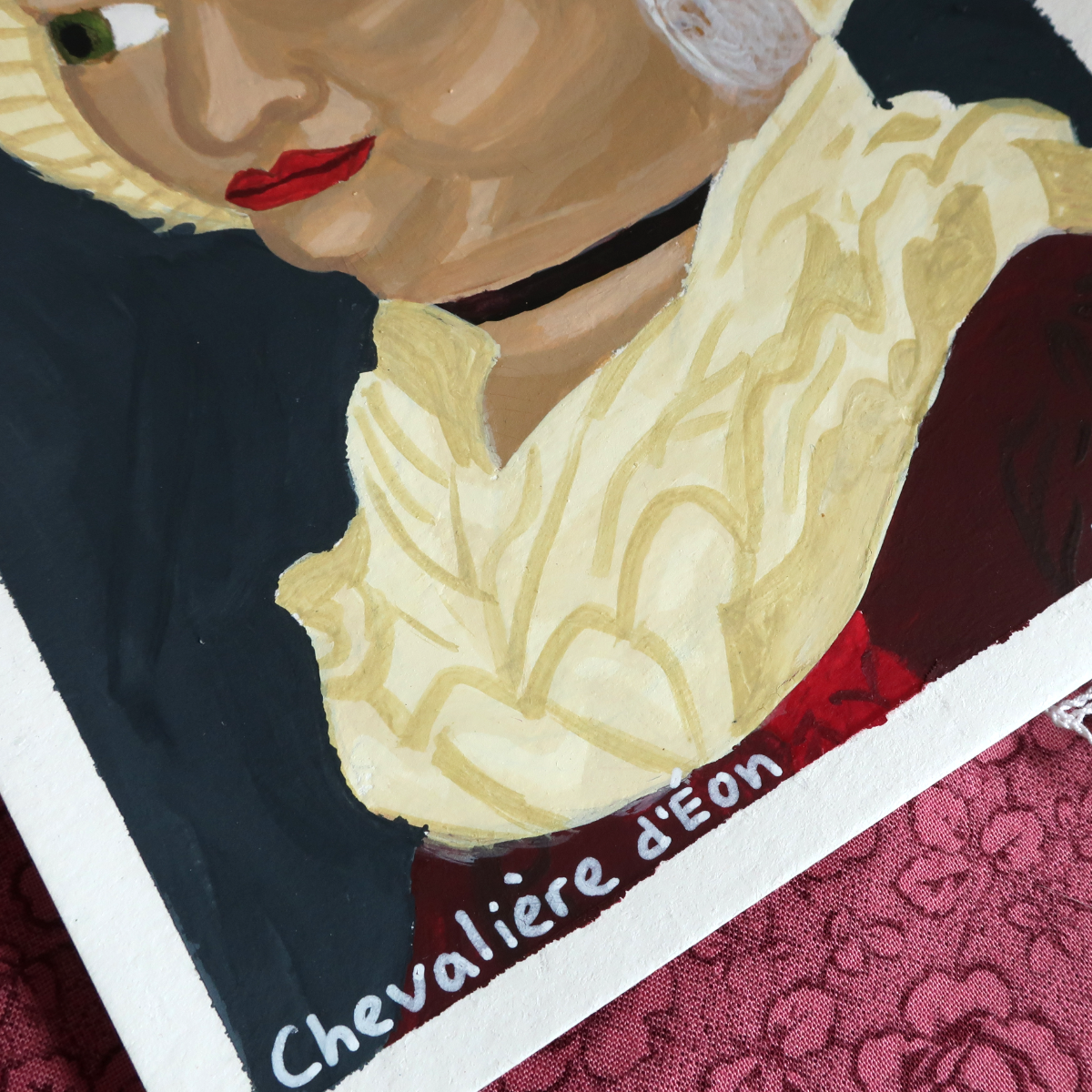
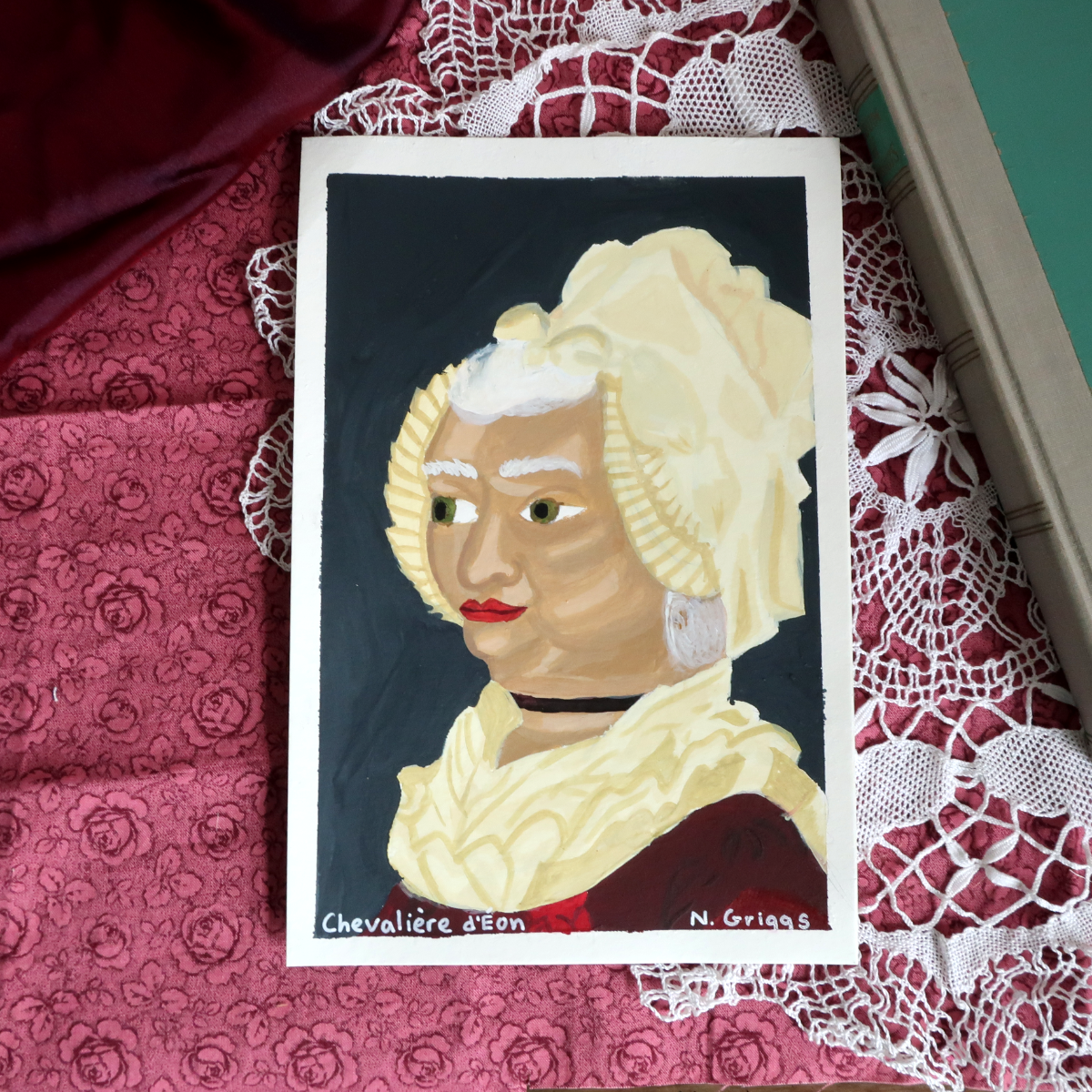
Fight for Who You Are | Chevalière d'Éon (1728-1810): Not Just Cistory
CW: this blog post contains descriptions of a transgender person's genitals as well as the disregard of her bodily autonomy. Medical language is used.
There is a certain special fascination people have for what is labeled 'different' or taboo'. This has long included the bodies of people who don't look exactly like what is deemed 'normal'. From 'freak shows' of the past to proposed bills today that require minors to undergo physical examination of their genitals and testing of hormone levels, namely testosterone, to prove their right to participate in high school sports (Sport Resolutions, 2022). Certain bodies have been considered public property and fodder for spectacle when a point needs to be made, or entertainment had.
The Chevalière d'Éon was subject to this scrutiny as well. There was a lot of discussion and speculation around what was under her dragoon uniform and dresses. There is some debate over whether she encouraged or discouraged this speculation, but either way, it would not have been such a long-enduring topic of discourse, or even a discussion at all, if d'Éon had simply been a cis woman.
For the duration of this blog post I have decided to use both she/her/hers and he/him/his pronouns, rather than they/them/theirs. Many of the contemporary articles about d'Éon have used they/them/theirs when referring to her. However, I have come to the conclusion that using these two sets of pronouns as appropriate is more authentic.
D'Éon referred to herself as either 'him' or 'her' throughout her life. While gender-neutral pronouns have existed since before d'Éon's time, I have not come across any evidence of her using them for herself. I will only be using he/him/his when d'Éon was 'living as a man', and not when she was 'living as a woman' or when speaking about d'Éon generally. this reflects that d'Éon chose to dress and live as a woman, even when it was not required of her.
The Advantage of a ‘Man’s’ Education
Charlotte-Geneviève-Louise-Augusta-Andréa-Timothéa d'Éon de Beaumont or Charles-Geneviève-Louis-Auguste-André-Timothée d'Éon de Beaumont (henceforth referred to as d'Éon, regardless of the gender she was presenting as) was born on the fifth of October, 1728 (Charles, Chevalier d’Éon de Beaumont | French Spy | Britannica, n.d.). She was part of "a noble family in Tonnerre, Burgundy" (Rotondi, 2024) and was, by all accounts raised as a boy. D'Éon claimed, later in life, to have been forcibly raised as a boy, despite her sex, to please a father who wanted a son (Rotondi, 2024). Whether this is factually true or not, is uncertain. However, it is possible, that this is how d'Éon's upbringing felt to her, regardless of how her family perceived her.
D'Éon was given the education expected of the son of a noble during this time and "excelled academically and graduated from law school" (Figes, 2021). Her education was certainly something most women were not afforded during the eighteenth century. "After graduating from Collège Mazarin... in 1749, the 21-year-old gained a literary reputation with [his] political writings" (Rotondi, 2024). This both hinted at his skill at politics as well as set him up for a life of intrigue and political play.
Spymistress D'Éon
D'Éon's life of espionage began 'in 1756 [.] "d’Eon was recruited for the Secret du Roi, or King's Secret, a network of spies working for French King Louis XV. D’Eon was sent to Russia in two capacities: Officially, as Secretary of the Embassy in St. Petersburg. Secretly, the King tasked d'Éon with gathering intelligence in the court of Empress Elizabeth in a bid to put a Frenchman on the Polish throne" (Rotondi, 2024). D'Éon must have been very good at being a spy, because she was one for a good portion of her life.
Russia may have opened d'Éon's eyes to the part of herself that was not what society assumed her to be. On the other hand, she could have known she was female for her entire life. Either way, she participated in the "weekly 'metamorphosis balls' [held by Empress Elizabeth,] where men of the court dressed as women and noblewomen, as men.... Gary Kates, author of Monsieur d’Eon Is a Woman*... [says] 'Every nobleman and noble lady would have known what it was like to cross-dress and did so all the time at masquerade balls'" (Rotondi, 2024). It was a tantalizing opportunity to flout social convention and ignore propriety, in favor of dressing up and having fun. This crossdressing was only acceptable so long as it was kept to these balls.
Later, when d'Éon was on her way to becoming a household name, she insisted that part of her role as a spy involved her dressing as a woman and that she "served as a lady-in-waiting to Empress Elizabeth, but there is little historical evidence to confirm this" (Rotondi, 2024). She flouted the implicit understanding that the crossdressing was to be kept to balls only. Not only, according to her, did she dress as a woman at formal functions, but she did so all of the time, fully living as one in service to her country.
Bram Stoker, of Dracula fame, wrote Famous Imposters and included the Chevalière d'Éon as a subject. He covers her time in Russia, assuming her claim that she was there pretending to be a woman was true. It does throw the rest of what he writes about her into doubt, but sharing what was believed about her one hundred years after her death, and what made her worth remembering to the world, is something to be included (with a grain of salt for you to take, of course).
Stoker describes her time in Russia as an undercover lady's maid and her return as her 'brother'. "In the following year he returned to France whence he was immediately sent again to St. Petersburg with the title of Secretary of Embassy. But this time he went in his man’s clothes and as the brother of the pretended female reader. By this time he had been made a lieutenant of dragoons" (Stoker, 1910, pp. 271–272).
As well as being a talented spy, D'Éon was also a talented military leader. "D’Eon... distinguished himself by his courage in the battles of Hoecht; of Ultrop, where he was wounded; of Eimbech where he put the Scotch to flight; and of Osterkirk, where at the head of 80 dragoons and 20 hussars he overthrew a battalion of the enemy" (Stoker, 1910, pp. 271–272). She continued to avail herself of her country and build goodwill upon which her identity would later be tolerated.
At the end of the Seven Years War, D'Éon "went to London in 1762, with the Duc de Nivernais... On returning to Versailles with the Treaty of Paris ratified... he received the cross of St. Louis" (Charles, Chevalier d’Éon de Beaumont | French Spy | Britannica, n.d.). It is clear that as well as being a sensationalist, and skilled spy, D'Éon was also trusted by the king.
He was well rewarded for his work and "[t]he newly minted Chevalier d’Eon was named Chargé d'Affaires and interim ambassador in London...." D’Eon's spy work continued. He was tasked with "Identifying locations for a sea invasion of England even as the two Kings were publicly proclaiming peace" (Rotondi, 2024). This job suited D'Éon, and she was reluctant to leave it.
France vs. D'Éon
However, nothing lasts forever, and "D'Éon was enjoying a luxurious London lifestyle when their replacement, the Comte de Guerchy, was named and d’Eon was demoted to secretary... 'D’Eon had a huge ego,' says Kates. '[He] thought [he was] the best person for the job.'" (Rotondi, 2024). This was not what the French Government wanted to hear, and it was now that her relationship with France began to sour.
Determined to get D'Éon back under France's direct control, "the French Foreign Ministry made several attempts to kidnap and arrest him. In retaliation, d’Eon intimated to his superiors in the Secret that he would tell everything if he wasn’t vindicated" (Rodriguez McRobbie, 2016). In 1764 "d'Éon published secret state correspondence to British audiences in a scandalous publication known as the Lettres, mémoires, et négociations" (Figes, 2021) as proof that he was serious about sharing what he knew. D'Éon was, apparently, not one to give up, or one to refuse to stoop to underhanded means to get what she wanted.
Fearing what might come out if he didn't capitulate, "Louis XV quietly gave D’Eon a lifelong pension of 12,000 livres annually, in exchange for reports about British politics and handing over the incriminating documents about the Secret he possessed.... and he was forbidden from returning to France" (Rodriguez McRobbie, 2016). In the end of this particular scandal, D'Éon was able to get out of the exchange, exactly what she wanted; the ability to continue as she was in London as a person of importance, even if, publicly she was no longer a member of the French government.
Speculation and Scandal
Now, she was something of a celebrity and a household name in London. It was during this stretch of time that speculations about her gender (what we would now label her 'sex') began to run rampant. "Popular broadsheets were printed portraying d’Eon as half man, half woman. The London Stock Exchange began taking bets on the Chevalier’s gender. Rather than refute the statements, the Chevalier fanned the flames, even challenging a prominent banker to a duel" (Rotondi, 2024). D'Éon appears to be a person who liked, or at least wasn't afraid of, scandal, and she continued to insist that she was a woman, and shared (and created) stories to fill in her life as she felt it should have been lived.
Regeime changes are not kind to blackmailers however, and "when Louis XV died in 1774, his son... Louis XVI... saw no utility in having effectively two foreign policies, one secret, and, moreover, he no longer wanted to invade Britain. So d’Eon was again a problem" that needed to be solved (Rodriguez McRobbie, 2016).
How do you negotiate with a negotiator? The French sent Pierre Beaumarchais. In 1775, he "approached d’Eon to negotiate his return to France and, crucially, the return of any documents he possessed pursuant to his spy work. After several months of discussion, d’Eon [acquiesced]... He would give up all papers and return to France as soon as possible" (Rodriguez McRobbie, 2016).
Of course, d'Éon must have gotten something pretty good out of the bargain to leave her exciting life of intrigue and celebrity. He was once again "offered a life annuity of 12,000 livres a year… and agreed to dress as a woman for the rest of [her] life in exchange for being legally proclaimed female" (Rotondi, 2024). "In 1777 he received the command; 'By order of the king: Charles-Geneviève-Louise-Auguste-Andrée-Timothée d’Éon de Beaumont is commanded to leave off the dragoon’s uniform which she is wearing, and to dress according to her sex'" (Charles, Chevalier d’Éon de Beaumont | French Spy | Britannica, n.d.). This might have been thought of as a punishment for d'Éon, or it may have been an opportunity to end the controversy by declaring her 'female', but whatever the case, d'Éon was only to happy to accept, and dressed and lived as a woman for the rest of her life, even after this agreement was void.
The king wasn't a radical supporter of a person's right to exist as who they are. Instead "'Louis 16th thought d’Eon really was and had always been a woman'... Plus, declaring d’Eon legally female was politically expedient: 'There weren’t women ambassadors or diplomats, so d’Eon couldn’t rise to power again....' (Rodriguez McRobbie, 2016). D'Éon was clearly a worthy political player regardless of speculation or gossip, and needed to be made as harmless as possible.
Not one to let gender roles, or the fact that France did not consider her fit for military service anymore, confine her , '[w]hen France entered the American Revolution on the side of the colonists in 1778, d’Eon offered to lead an army of women. The offer was declined" (Rotondi, 2024).
Unable to continue with her career in espionage, and not able to fight for her country, or its allies, as a legal woman, she "forged a new career performing fencing demonstrations. Popular prints show d’Eon fencing in a black dress... [and] the Croix de St Louis during these fights" (The Chevalier d’Eon - National Portrait Gallery, 2024).
She was able to still make ends meet even "[w]hen the French Revolution began in 1789, [and her] annual French pension was suspended and money became scarce" (The Chevalier D’Eon, n.d.). With her public fencing exhibitions and despite no longer being relied on by the king or an empress, many eyes were still on d'Éon.
At the end of the revolution, d'Éon "was now legally free to dress as [she] pleased. D’Eon chose to dress exclusively as a woman for the final 33 years of [her] life" (Rotondi, 2024). It is her decision to continue living and dressing as a woman even after she was no longer was required to, that makes me, as a transgender individual look to d'Éon and say 'I know you.'
As d'Éon aged, her ability to perform would have waned. She had lived lavishly throughout her life. Her spending combined with the loss of her allowance meant she "spent several months in prison for unpaid debts. In 1805 [she] received an advance from a publisher to write [her] Memoirs" (Figes, 2021), a perfect project for a storyteller like her.
Historians theorize that these memoirs were both at least partially ghostwritten, and fictionalized. The manuscript was never published (Rotondi, 2024). In her final years she grew "increasingly religious and [wrote] “What I am writing is not for the feeble souls of this century... How much I have suffered in body and soul. All that I know is that my transformation has made me into a new creature' (Rotondi, 2024). I can only speculate to the meaning of these lines, but they resonate in a way that is also familiar.
At the very end of her life, "the Chevalier lived with a widowed friend, Mrs[.] Coles, in modest circumstances.... d'Eon died in poverty in May 1810, at the age of 81... (The Chevalier D’Eon, n.d.). When her death was discovered, doctors were sent for.
CW: this next section contains descriptions of a transgender person's genitals as well as the disregard of her bodily autonomy. Medical language is used.
An inspection of her her body was done, and an anatomical drawing of her genitals was made in order to prove that she was actually a male. This illustration is available to view digitally as an archived item in the British Museum's collection. The piece is described as an "Anatomical drawing of the penis and emaciated thighs of Charles Genevieve Louis Auguste Andree Timothee D'Eon de Beaumont (called the Chevalier D'Eon), drapery over the stomach and beneath the buttocks..." (Turner, 1810). The meta data for the image includes a transcription of the inscription:
Drawn from the Body of the Chevalier D'Eon, May 24. 1810. I hereby certify that I have inspected & dissected the Body of the Chevalier D'Eon, in the presence of Mr. Adair, Mr. Wilson, & Le Pere Elizee, & have found the Male Organs in every respect, perfectly formed. May 23rd. 1810. Golden Square. In consequence of a note from the above Gentleman, I examined the Body, which was a Male; - the original Drawing was made by Mr. C. Turner, in my presence. Dean Street, Soho. May 24th. 1810. and inscribed London Published June 14th 1810 by C Turner (Turner, 1810)
When the results of the examination of d'Éon's body were published society “painted d’Eon as one of the greatest con men in history—an actor who made people believe something that was utterly untrue..." (Rotondi, 2024). A life full of adventure, intrigue, and loyalty was pushed aside in favor of the scandal of d'Éon's body and the shape it took, and utterly unfair rendition of a life that repeats even today.
D'Éon, and Today: A Dreadful Tradition
This gross invasion of privacy and disrespect to a woman who had made her gender known repeatedly and incredibly publicly, is sadly typical of the sort of public ownership assumed over transgender bodies. Courts decide whether we can compete in sports, or receive gender affirming care, and the public takes for granted that trans folks are willing to share all about 'what's in their pants', and that it is acceptable to pick apart every aspect of someone's appearance to determine whether they are transgender or not.
This attention ranges from distasteful, to discomfiting, to dangerous, and is continues to be one way society exerts control over individuals who do not fit neatly into the boxes deemed appropriate to society. This is not something exclusive to transgender individuals, disabled folks, people of color, and fat people, amongst others all receive this treatment too.
Charlotte-Geneviève-Louise-Augusta-Andréa-Timothéa d'Éon de Beaumont was an incredibly intelligent woman, with, apparently, an ego to match. She both supported and thwarted kings and empresses, and defied social convention for decades. She was sure of who she was, and made it known to the world. While it may not be advisable for all of us to become spies for kings, or act as emissaries for the countries we live in, we could perhaps emulate the Chevalière d'Éon in our bravery and determination to live as our authentic selves, propriety be damned.
The original painting featured in this blog is available for purchase.
NOTE! Some links (those with an * next to the name) are affiliate links. I will receive a small commission if you use these links to purchase something. It will not change the price of the product for you.
References
Charles, chevalier d’Éon de Beaumont | French spy | Britannica. (n.d.). Www.britannica.com; Encyclopedia Britannica . Retrieved March 17, 2026, from https://www.britannica.com/biography/Charles-chevalier-dEon-de-Beaumont
Figes, L. (2021, February 23). The gender fluidity of the Chevalier d’Éon. Artuk.org; Art UK. https://artuk.org/discover/stories/the-gender-fluidity-of-the-chevalier-don
Rodriguez McRobbie, L. (2016, July 29). The Incredible Chevalier d’Eon, Who Left France as a Male Spy and Returned as a Christian Woman. Atlas Obscura. https://www.atlasobscura.com/articles/the-incredible-chevalier-deon-who-left-france-as-a-male-spy-and-returned-as-a-christian-woman
Rotondi, J. P. (2024, January 10). The French Diplomat Who Lived as Both a Man and a Woman | HISTORY. HISTORY. https://www.history.com/articles/chevalier-d-eon-french-spy-man-woman
Sport Resolutions. (2022, June 6). Ohio transgender athletes bill allows doctors to examine genitalia. Sportresolutions.com; Sport Resolutions. https://www.sportresolutions.com/news/ohio-transgender-athletes-bill-allows-doctors-to-examine-genitalia
Stoker, B. (1910). Famous Impostors (pp. 271–272). STURGIS & WALTON COMPANY. https://www.gutenberg.org/files/51391/51391-h/51391-h.htm#IX_THE_CHEVALIER_DEON
The Chevalier d’Eon - National Portrait Gallery. (2024). Npg.org.uk; National Portrait Gallery. https://www.npg.org.uk/collections/research/new-research-on-the-collection/the-chevalier-deon
The Chevalier d’Eon. (n.d.). The British Museum. Retrieved March 19, 2026, from https://www.britishmuseum.org/collection/desire-love-and-identity/chevalier-deon
Turner, C. (1810). 1868,0808.7947 [Hand-colored, stipple]. The British Museum. https://www.britishmuseum.org/collection/object/P_1868-0808-7947